
|
--
- Close the US Bases in Okinawa! Passed by the SPUSA International Commission May 25, 2010 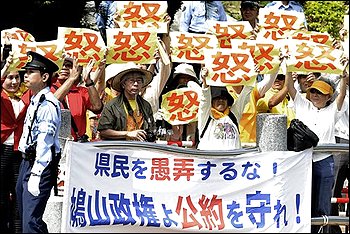 Even
as the United States wages war in two countries and continues to
aggressively confront Iran, the military is seeking to expand its
operations in the Pacific and East Asia. Critical to these plans are
the military bases in Japan. Since the end of the Second World War,
Japan has served as the primary base of American forces in the region.
Although the Occupation of Japan ended in 1952, the islands of Okinawa
Prefecture remained possessions of the United States military until
returned to Japan in 1972. Even
as the United States wages war in two countries and continues to
aggressively confront Iran, the military is seeking to expand its
operations in the Pacific and East Asia. Critical to these plans are
the military bases in Japan. Since the end of the Second World War,
Japan has served as the primary base of American forces in the region.
Although the Occupation of Japan ended in 1952, the islands of Okinawa
Prefecture remained possessions of the United States military until
returned to Japan in 1972.At present, approximately 36,000 military personnel reside in Japan. This represents approximately one-half of all American overseas forces in the Pacific and East Asia. An additional 11,000 military personnel reside aboard vessels based in Japan. Furthermore, 43,000 dependents and 5,000 civilian contractors also live in the country, bringing the total American military population of Japan to 95,000. 85 bases of various sizes operate within Japan. The government of Japan and the American military have based nearly three-quarters of all military personnel on the island of Okinawa, where only one percent of the total Japanese population lives. Compounding this disproportionate burden, American military installations occupy 10.4 percent of the used land of the island. Many of these bases abut with heavily populated areas. An average of 4,000 accidents and crimes involving American troops occur every year. More than 1,000 Japanese civilians have died in these incidents. Currently, one of these bases, Marine Corps Air Station Futenma, is scheduled for relocation. Futenma is located in the 89,000-person Ginowan City and occupies one-quarter of the city's total area. In addition to local concerns about accidents and crimes, the citizens of Ginowan have complained about low-flying aircraft, noise, pollution, and the partial extraterritoriality protections of American service members. In 2005, the American and Japanese governments agreed to move Futenma to Nago City in the more rural northeastern portion of Okinawa. In 2009, however, the long-ruling Liberal Democratic Party was thrown out of office and the Democratic Party of Japan swept into power. Part of the DPJ's success in Okinawa was attributed to the campaign pledges to forge a more equal relationship between Japan and the United States, and to relocate Futenma outside of Okinawa Prefecture. Since then, the Hatoyama Administration has publically sought to fulfill these pledges. It has, however, faced considerable opposition from the United States. The Obama Administration has refused suggestions of moving the base to either Kagoshima Prefecture or to Guam, and has repeatedly rebuked the Japanese government. Finally, on May 5th, Prime Minister Hatoyama backed down from the Futenma pledge, later saying that it was only a personal goal. Familiar with the nature of capitalism and its need for supremacy over others, this subservience to the hegemon is not surprising to us socialists. It is, however, a great blow to the aspirations and desires of the Okinawan people. It is further evidence that the United States government cares not for the will of the local people. It is another obstacle to world peace thrown down from the capitalist heights. But it is not the end. 11,000 people rallied against relocating Futenma to Tokunoshima in Kagoshima Prefecture, a proposed alternative with a population of 12,700. Another 90,000 people rallied in Okinawa against keeping the base. Even the Liberal Democratic Party, ordinarily fast friends with American capitalism, was represented at the rally. The people of Guam, already hosts to significant military operations, have also rallied against further burdens. As a central aspect of our commitment to world peace, the Socialist Party USA stands for the unconditional disarmament of the United States. We therefore call for the immediate closing of Futenma and all other bases in Japan. We stand in support of the people of Okinawa, Kagoshima, and Guam in their opposition to the tools of imperialism. We look to our comrades in Japan to provide guidance in the continuing struggle. We call on all comrades to build solidarity with our comrades across the Pacific. - |
||
|
Socialist
Party
USA
339
Lafayette
St.
#303
New
York,
NY
10012 |